Episodes Guest Interviews
 (opens in a new tab)

 (opens in a new tab)

Dr. José Aranguren is the founder of Zarc, a sponsor of this episode.
Guest Interviews
The Evolution of Endo Smaller Files, Bigger Ideas with Dr. José Aranguren
Guests in this episode
-
Dr. José Aranguren — Endodontist · Founder of Zarc
Endodontist practicing in Spain and Austria; professor and department chair at Complutense University in Madrid; President of the Spanish Association of Endodontics; founder of Zarc.
Monday-morning takeaway
Shape less, but don't clean less. Dr. José Aranguren keeps the coronal shape small to protect peripheral dentin, still cleans the apical third when the case calls for it, and keeps each file in the canal as briefly as possible.
Chapters
- —MAPEX: minimal preparation, extended apical cleaning
- —The future: coated files, file-free endo, and endo without bleach
Clinical pearls
Dr. José Aranguren: Preserving dentin is easy if you don't clean. His MAPEX idea is to keep the maximum flute diameter below 0.80 mm and still clean the apical part, enlarging to a 35 or 40 apical size in necrotic cases when needed. In his opinion a glider creates a glide path; it isn't for shaping a canal with bacteria in it.
Dr. José Aranguren: Activation needs room to work. In his view, sonic and ultrasonic activation are powerful in big oval canals but do little in small, low-taper canals, because the tip touches the wall and can't produce acoustic streaming. He treats irrigation as creating a current: positive irrigation, suction, frequent exchange, then activation by down pack, EDDY, cone in-and-out or laser.
Dr. José Aranguren: Once he trusted a glider not to break, he changed his sequence. He takes the glider a short way in first, then a long 8 K-file and the apex locator to establish length, then the glider to length. "In that moment, the most difficult part of the root canal is done." (He avoided gliders for years because most were weak. The glider he uses is a Zarc product.)
Dr. José Aranguren: Keep files in the canal as briefly as possible. The first file goes in a pecking motion, not brushing: advance, back off half a millimeter, push deeper, and after three pushes remove it, clean the flutes, irrigate and check patency. Every later file goes to working length and straight out, because more time and more passes open the coronal access, straighten the canal and add cyclic stress.
Dr. José Aranguren: Think twice before extracting every wisdom tooth. He calls it a "spare tire": when a molar is lost to a vertical fracture, a wisdom tooth can be a donor for autotransplantation, which he plans with CBCT and guides.
Where we disagree
rotary speed for Avalon and Zarc files
Dr. José Aranguren
500 RPM for every Avalon and Zarc file. They're martensitic and designed for that speed, which restores their cutting efficiency, and he says going faster won't cause more problems. Brett runs them at 500 too and says they feel better.
Bill
Runs them at 300 RPM, including the EVO glider, and says that works. José's answer: you give up cutting efficiency. Bill left the door open to cranking the speed up on his next case.
Show notes
Our first in-studio guest, Dr. José Aranguren, joins Brett and Bill in Chicago. José is an endodontist practicing in Spain and Austria, professor and department chair at Complutense University in Madrid, and founder of Zarc. He traces his path from a single lecture to a career built on smaller shapes: why he moved away from big tapers to protect peripheral dentin, why clinicians belong in the room when files are designed, and his MAPEX idea. He walks through his glider-first protocol, irrigation and lasers, a friendly debate over rotary speed, the push for specialty recognition in Spain, and why he calls the wisdom tooth a spare tire.
For professional education. Content reflects the hosts' clinical experience and is not a substitute for individual clinical judgment.
Shorts from this episode
All 14 on the Shorts page →In this conversation
Co-Founder & Host
Dr. Brett Gilbert
Co-Founder & Host
Dr. Bill Nudera
Keep listening
Got a case like this? Send it in →
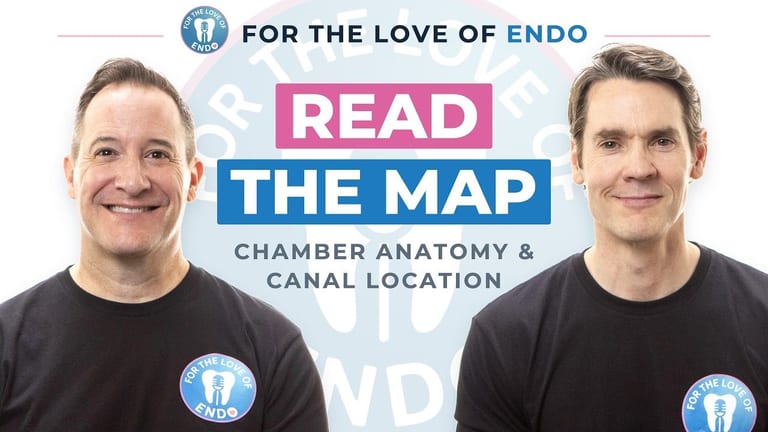
READ THE MAP — Chamber Anatomy & Canal Location
Find canals from the CEJ and the color of the pulp floor, not the occlusal anatomy. Then treat the canals you find before hunting for the one you can't.
Flagship Partner

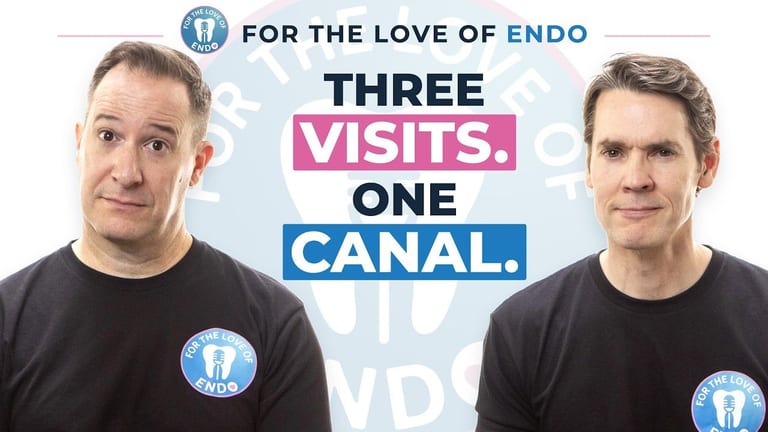
Three Visits One Canal
No canal on the CBCT. A lesion at the apex. In FTLOE's first case presentation, Dr. Brett Gilbert walks Dr. Bill Nudera through a three-visit case on a necrotic maxillary first molar, and how to find a calcified palatal canal without perforating the root.
Flagship Partner